
Recorded Deed Types in Wexford County
The Register of Deeds files a wide mix of instruments in Wexford County: warranty, quitclaim, administrator, tax, and sheriff deeds, plus land patents, leases, land contracts, mortgages, liens, probate orders, surveys, and plats. Each label tells you the instrument's form or where its authority came from. A label alone settles nothing about title, though. A quitclaim still conveys whatever the grantor held, no more. Read the deed itself before drawing conclusions.
| Deed Type | What It Does | Common Use |
|---|---|---|
| Warranty deed | Conveys the stated interest with warranties in the instrument | Conventional sale |
| Quitclaim deed | Conveys whatever interest the grantor holds | Family transfer or title cleanup |
| Administrator deed | Conveys under estate authority | Probate administration |
| Sheriff deed | Records a transfer arising from a sheriff sale | Foreclosure process |
| Tax deed | Records a tax-process conveyance | Delinquent-tax disposition |
Keep the instrument types straight. A deed transfers an interest, while a mortgage, mechanics lien, tax lien, or judgment notice burdens it instead. An assignment hands a mortgage to a new holder. A discharge or satisfaction records that the debt is gone. All of these can crowd the same name index in Wexford County, sitting near one another even though they do entirely different jobs.
Enter a Name in Wexford's Tyler Index
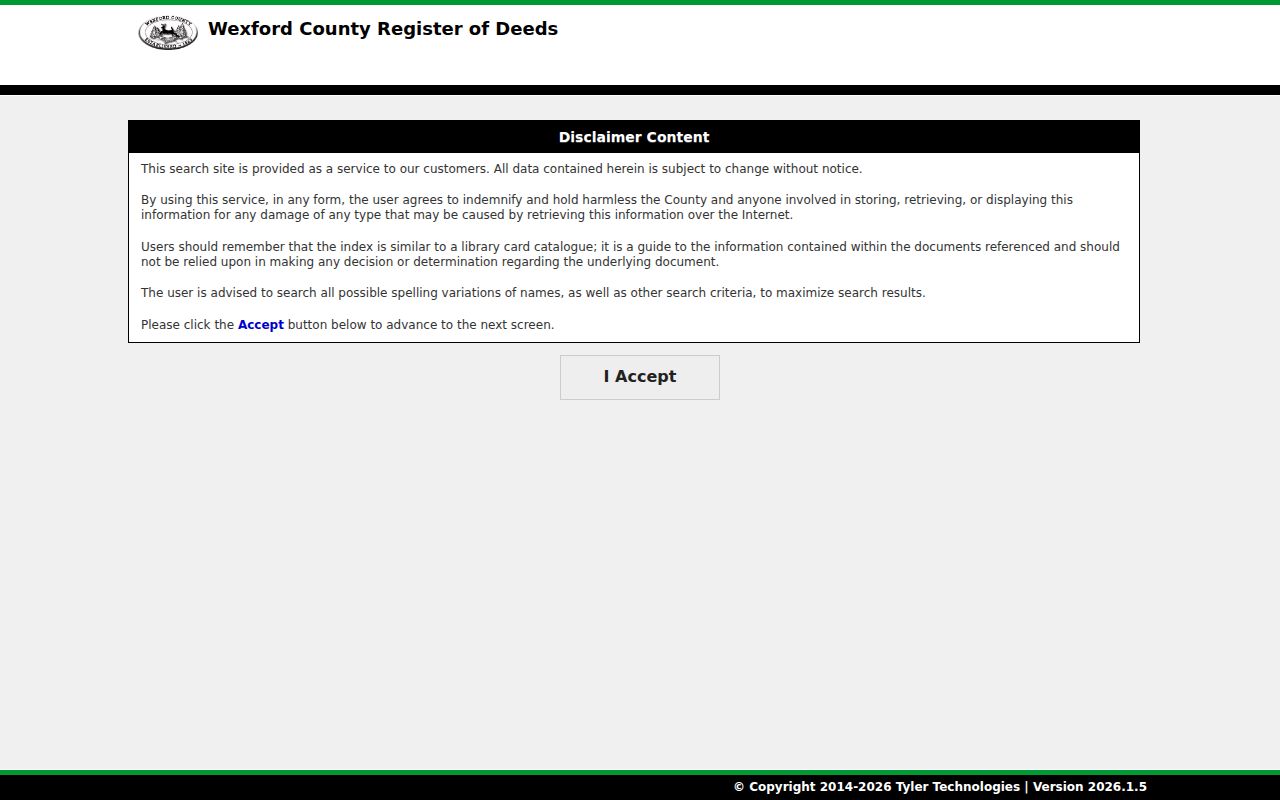
The Tyler public document search wants individual names entered surname first. Begin wide with the Either Party option. Narrow to grantor or grantee only after the likely direction of the transfer becomes clear. Spelling variants matter here. Initials, transcription slips, trusts, estates, and organizations often hide under alternate spellings of the very same name in Wexford County property records.
| Search input | Purpose | Search note |
|---|---|---|
| Either Party | Looks across both sides of an instrument | Useful first name search |
| Grantor / Grantee | Separates giver from recipient | Supports backward chaining |
| Recording Date Start / End | Limits results by mm/dd/yyyy dates | Allow for execution-to-recording delay |
| Document Number | Targets one indexed instrument | Verify the image |
| Book and Page | Uses a liber/page citation | Preserve both values exactly |
| Document Types | Filters instrument classes | Full dropdown was not captured |
The Three Coverage Dates Behind Wexford Deeds
Wexford's coverage dates layer on top of each other rather than conflict. The office traces its land records to 1864. Its office page describes a computer image index reaching January 1968, while the FAQ points to scanned and indexed material from 1965 forward. The live portal itself labels the certified recorder-document range as beginning January 1, 1976. Name the layer you actually searched. Calling any single date the universal online start is misleading.
Books, microfiche, scanned images, and microfilm offer other routes. Recorded entries are computer-indexed daily, scanned, and microfilmed, with duplicate film stored in Grand Rapids. When a deed predates the web range, ask staff for the right book or film. Never abandon the chain just because the portal stops.
Trace a Wexford Chain from Grantee to Grantor
Run a chain backward from a likely present owner found through Equalization or GIS. One caution comes straight from the Register FAQ. It directs an address-only researcher to the assessor first, since Wexford deeds are indexed by party name rather than street address.
- Search the current name as grantee over an approximate acquisition period.
- Open the likely deed and copy every party, date, instrument or liber/page reference, and the full legal description.
- Search that deed's grantor as grantee to locate the earlier acquisition.
- Branch through trustee, personal-representative, entity, survivorship, or probate names when the party changes form.
- Move to office books, microfiche, or microfilm when the chain crosses the digital range.
- Grantor
- The party transferring the stated interest.
- Grantee
- The party receiving the stated interest.
- Chain of title
- The ordered sequence of instruments linking ownership through time.
- Book/Page versus instrument number
- Two recording-reference systems; retain whichever the record displays.
Liber, Page, Instrument Number, and Image Must Agree
Treat an index row like a card-catalog entry, nothing more. Tyler's own disclaimer warns that data can change. It also says the index is not the legal record. Open the image and compare the details against the row. Check party names, recording date, document type, liber/page or instrument number, and the legal description. A later mortgage, release, probate order, or deed may cite an earlier reference. Follow it, even when your name query missed it.
Rural parcels need township, section, range, quarter calls, and acreage preserved exactly. Platted land needs the precise subdivision, lot, and block wording. For a condominium, hunt down the master deed. Find the unit owner's deed too, in the Wexford County property records.
The August to October 2024 Recording Gap
One stretch deserves special care. The Register reported a November 5, 2024 cyber incident. It says fewer than five percent of documents recorded before it remained unrecovered. The hardest-hit window ran August 14 through October 30, 2024. A missing image from that stretch is a reason to confirm with the office. It is not proof that the conveyance or lien never existed.
Build a timeline covering execution date, recording date, and instrument number. Add image availability, tax-roll owner, and assessment update. Include any related mortgage or release as well. Then contact the Register of Deeds to request a paper, microfilm, or backup check. Ask whether re-recording makes sense.
Recorded Plats, Surveys, Easements, and Restrictions
The deed trail stretches past deeds in Wexford County. The Register also records subdivision plats, certified surveys, and government corners. Agreements, land contracts, and other instruments can clarify a description or burden the land. Only recorded surveys are available through the Register, per the county FAQ. Mortgage surveys are not. A GIS line or lender sketch never substitutes for a recorded survey.
Old descriptions may cite plats like Mitchell's Revised Plat of the Village of Clam Lake. They may also cite additions tied to Courthouse Hill. Search the exact plat title and its recording reference. Equalization neighborhood labels can spark search clues, but a valuation category is not automatically a recorded subdivision.
Mortgage Releases Are Not New Deeds
A paid mortgage normally ends with a discharge, release, or satisfaction, not a fresh deed. To test an encumbrance chain in Wexford County property records, find the mortgage first. Then trace each assignment. Finally, locate the recorded release. A missing release image may call for a lender or office inquiry. The index by itself never establishes a current payoff.
Likewise, a death does not automatically trigger a replacement deed from the Register. The FAQ tells a survivor or spouse to bring a certified death certificate. It also requires recording fees. The operative result may hinge on survivorship language, an affidavit, or a trust instrument. Probate authority, a court order, or a later deed may also decide it.
Connect an Estate Transfer to Wexford Probate
When a chain of title shifts after an owner dies, the explanation usually sits in probate. An owner has died. An administrator deed, a probate order, or a later fiduciary deed can clarify the change. So can a death certificate, trust instrument, or survivorship filing. Wexford Probate Court administers estates, trusts, guardianships, and conservatorships. A file search works best with the deceased person's full name and death date. It also helps to have approximate county residence, parcel address, and any known instrument date.
Probate records establish authority and context. They do not replace the recorded conveyance itself. The Register FAQ allows a surviving spouse or another requester to bring a certified death certificate and recording fees. The office will not issue a new deed, though. When the right transfer instrument is unclear, read the existing vesting language. Get legal advice before acting.
Wexford Fraud Notify Watches Names, Not Parcels
The Register offers a Fraud Notify service that sends alerts keyed to a name. A new alert goes out whenever a document is recorded under that name. Enrolling can tip an owner off to an instrument indexed under the registered name. It is not continuous title monitoring, though, and it does not validate anything. Register every name variant the service allows. Keep the confirmation email. When an alert arrives, weigh it against the actual recorded image. Check it against the parcel legal description too.
Continue a Wexford Deed Chain Before the Web Range
A chain may run past the portal-certified 1976 start. Carry the last dependable party, recording year, legal description, and liber/page reference into the Register's earlier collection. Coverage there reaches back into the 1960s as computer images or scans. But the medium shifts from year to year. Before searching further, ask whether the next step belongs in an index, a scan, a paper book, microfiche, or microfilm. Record the medium beside each citation.
Historical atlases help when a tract's address has vanished. The State Library lists a 1908 standard atlas, a 1956 farm plat book, and an approximately 1930 Hixson source. It also holds a 1980/81 land atlas. Any of these might surface a former road, owner, farm, or neighbor. Treat them as leads rather than conveyances. Confirm every step in the deed book, and keep the plat title and legal-description spelling exactly as written.
Railroads, lumber companies, churches, schools, municipalities, estates, trusts, and successor entities can all stand in for a person's name. Search the organization as it was indexed, and follow trustees, officers, or representatives only where an official instrument names them. Michigan's MiBusiness Registry may supply a filing lead. But the recorded deed remains the evidence tying an entity to the land.
Connect Probate Authority to a Wexford Deed
Probate files can name a personal representative. They may issue letters of authority. They can also include an inventory or an order allowing sale or distribution. Tie that authority to whatever followed. It might be an administrator deed, a probate order, a survivorship document, an affidavit, a trust instrument, or a later conveyance recorded with the Register. A docket missing from public view does not mean no estate existed.
A certified death record and an obituary serve different evidentiary purposes. Hang onto the deceased owner's full name, the death date, the parcel description, the probate case reference, and the recording citation. Anyone can reconstruct the transition later with those pieces.
Order a Wexford County Deed Copy
Probate records may identify a personal representative. They may also show letters of authority, inventory, or an order permitting sale or distribution. Match that authority to the administrator deed, probate order, survivorship document, affidavit, trust instrument, or later conveyance recorded with the Register. A missing public docket proves nothing. It does not establish that no estate existed.
A certified death record and an obituary play different evidentiary roles. Preserve the deceased owner's full name, death date, parcel description, probate case reference, and recording citation. That way the transition can be reproduced.
Recorded, not guaranteed. Wexford County deed records show what reached the recording system. They do not resolve unrecorded interests, competing claims, legal sufficiency, or the present effect of every instrument; obtain qualified title review when certainty matters.